The core difference
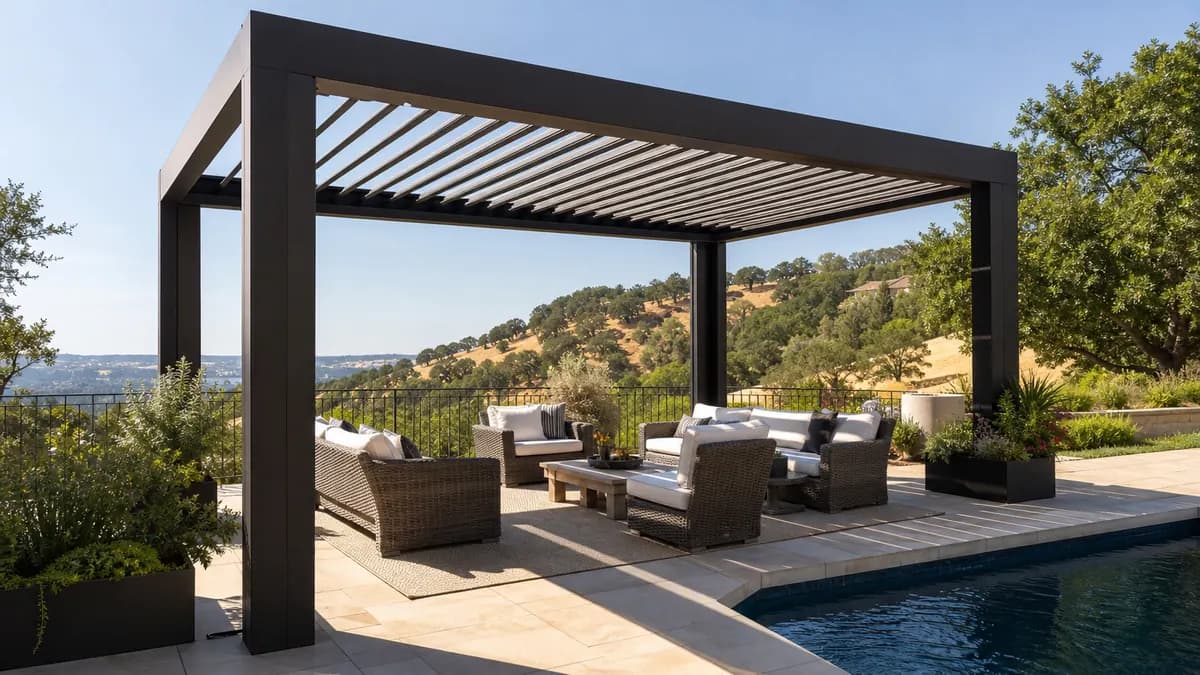
A solid patio cover has a fixed roof, usually aluminum pan or insulated foam-core panel, that shades and sheds rain all day. A louvered pergola has a roof made of rotating aluminum blades. Open them to let in light and air, tilt them to block the sun, or close them to shed rain. Louvered systems are typically motorized, with an optional rain sensor, and finishes are powder-coated aluminum. Precise blade angles and rain-sensor specs differ by product, so ask for the spec sheet.
| Factor | Louvered pergola | Solid patio cover |
|---|---|---|
| Roof | Adjustable aluminum blades | Fixed solid or insulated panel |
| Typical installed cost | $55-$125 per sq ft motorized; $45-$110 manual | $20-$50 per sq ft aluminum; $30-$60 insulated |
| Shade control | Adjustable through the day | Fixed, constant shade |
| Heat | Venting helps; closed blades give shade only | Insulated panels reduce heat transfer |
| Rain | Shed when closed; seals vary by product | Fully covered |
| Typical placement | Often freestanding; attached versions exist | Usually attached to the house |
| Maintenance | Motors, sensors and gutters to check | Mainly rinsing and sealant checks |
Costs are typical national ranges and vary by size, product and site. Some contractors report $120-$160 per sq ft for most motorized projects, and Sacramento dealers have quoted $40,000-$60,000 for premium units. The installer's written quote is what counts.
Shade, heat and light in a Sacramento summer
Sacramento sees about 23 days a year at or above 100 degrees F and mid-90s average July highs. Louvers let you open the roof on cool mornings and mild evenings, close it against hot afternoon sun, and vent trapped heat on warm nights. A solid roof gives steady shade, and an insulated patio cover with 3-, 4- or 6-inch foam-core panels (R-13.95 for a 3-inch panel per one vendor) cuts heat more than louvers can when closed. Vendors claim 15-20 degrees F cooler under insulated panels, which is a marketing claim.
Light and sky views
Louvers keep the patio from feeling like a room. Solid covers can feel dark unless you add skylight panels or recessed lighting.
Wind and rain
Closed louvers shed rain, but gutters and seals differ by product. Valley winter storms are modest, though foothill sites in El Dorado Hills and Cameron Park get snow-country loads (minimum roof snow load 20 psf county-wide), which affects how a louvered system must be engineered.
Attached or freestanding
A solid cover is normally attached to the house with a ledger and posts. Louvered pergolas are often freestanding, which suits poolside seating and outdoor kitchens away from the wall, but both attached and freestanding versions are made. See louvered pergolas for the options.
Footings and structure
Freestanding systems need four or more posts on footings or an engineered slab, since there is no wall to lean on. Depth and size are set by the product's evaluation report or the engineer, not a rule of thumb.
Permits and approvals
Attached covers of either type need a building permit in the City of Sacramento, Sacramento County, Elk Grove, Roseville and Rocklin. Freestanding covers under 120 sq ft are exempt from a permit under the statewide baseline but still need to meet zoning. Many freestanding louvered pergolas are larger than 120 sq ft and need a permit; any electrical for motors and lighting does too.
Solid aluminum covers often carry an ICC-ES or IAPMO evaluation report accepted by several local departments, and Sacramento County's GI-38 standard plan covers attached lattice and solid covers. Louvered systems are less likely to fit a standard plan, so expect engineering or a product-specific report. Placer County also requires a Class A roof assembly on covered roof structures. Details are in the patio cover permits guide.
Cost and long-term ownership
A louvered system can cost two to three times as much per square foot as a solid aluminum cover, and the motor, rain sensor and any smart-home integration are the pieces most likely to need service. Solid covers are mostly passive. Over a 20-year horizon, ask each installer about parts availability for motors and the finish. Our cost guide puts every type side by side.
Power and controls
Motorized louvers need a power run to the pergola. Ask whether there is a manual override for outages.
Which fits your yard?
- Louvered: poolside or freestanding seating where you want adjustable light and have the budget.
- Solid aluminum: a lower-cost, always-shaded cover over a dining area attached to the house.
- Insulated: the best choice when summer cooling matters most.
- Pergola with an open roof: dappled shade at lower cost; see pergolas.
To compare actual quotes, start at the homepage for patio covers in Sacramento, and we will connect you with licensed local installers.
Neighborhood and HOA considerations
Newer subdivisions in places like Elk Grove, Natomas and Roseville often have associations that care about height, color and visibility from the street. A freestanding louvered structure can read as bigger than an attached cover. See patio cover HOA approval for what committees ask for.
Back to the main guide: patio covers in Sacramento.