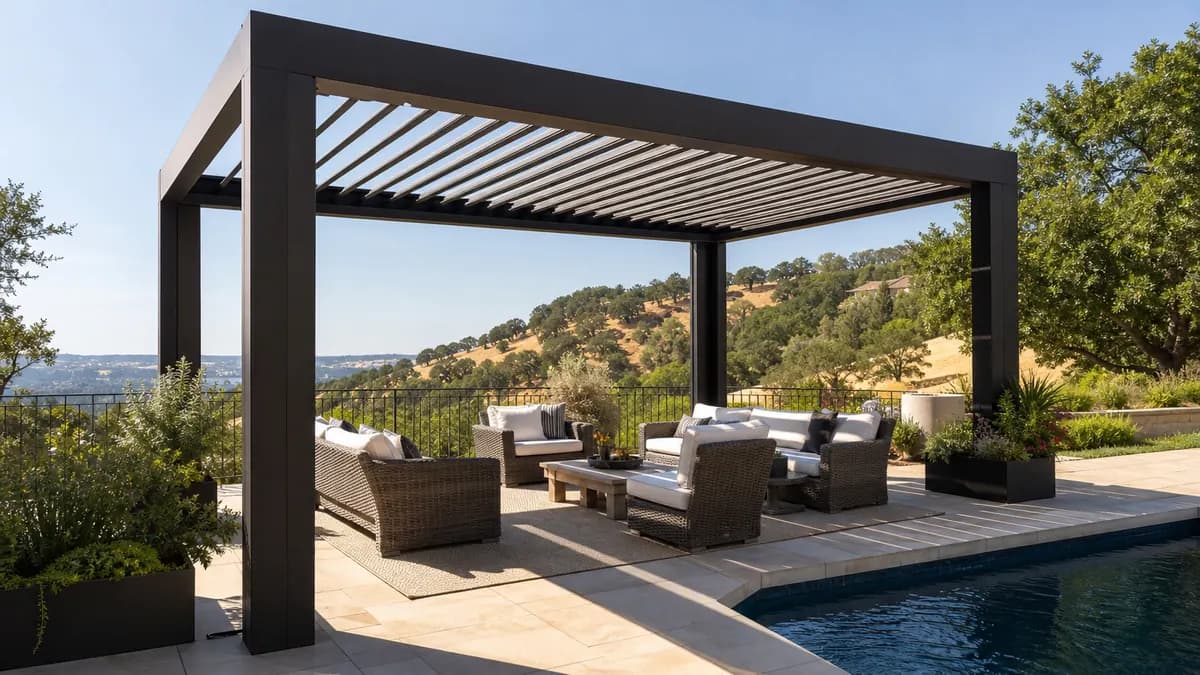
How a louvered roof works
The roof is a row of aluminum blades, called louvers, mounted on pivots between two side beams. Rotating the blades together changes the roof from solid to open. Closed, the blades overlap and form a pitched surface that sheds water. Rotated open, they let in sunlight and breeze, much like a plantation shutter on its side.
Rotation range varies by product. Many systems turn the blades 0 to 90 degrees, and some advertise up to about 130 degrees. A wider range gives finer control over low-angle sun in late afternoon.
Motorized versus manual louvers
Motorized
A motorized pergola uses an electric motor to rotate the blades, controlled by a wall switch, a remote or a smartphone app. Options commonly include rain sensors, wind sensors, integrated LED lighting and heaters, with smart-home integration on some models. A powered unit needs a dedicated electrical circuit, which is permitted electrical work.
Manual
A manual pergola uses a hand crank or lever to tilt the blades together. It costs less, has no motor to fail and needs no power, but you have to close it yourself when a storm blows in. Manual units suit homeowners who use the space on a schedule and do not mind adjusting it.
Rain and wind sensors
A rain sensor mounts on the frame and closes the blades when it detects moisture. A wind sensor can close or open them to limit loading in gusts. Ask the installer exactly which sensors are in the quote and whether the controller can be overridden manually after a power outage.
Drainage and water handling
Closed louvers channel water to the side beams, which contain a gutter. From there it runs down the hollow posts and out at the base through internal downspouts. That keeps water from dripping through the louver gaps onto your seating.
Where water exits the posts matters. Ask where the discharge points are and how they will drain across your slab, pavers or lawn. Heavy rain can overwhelm a gutter that was sized for light storms, and the Sacramento Valley gets short, intense winter downpours.
Frame, finish and sizing
Aluminum frame and powder coat
The frame is typically extruded aluminum with a powder-coated finish. Common colors are black, bronze, white and gray. Powder coating resists chalking and fading better than ordinary paint, though dark colors will still run hotter to the touch in July.
Sizes and spans
Most residential louvered pergolas are built as modular units, commonly in widths and depths in the range of 10 to 20 ft, with larger layouts made by joining bays. Blade length is limited by the product, so wider patios often add a middle beam or extra posts.
Attached or freestanding
A louvered pergola can be freestanding on four posts, as over a pool deck, or attached to the house along one side. Attaching it makes it a patio cover for permit purposes in every jurisdiction we serve. Freestanding units over 120 sq ft also need a permit in places such as the City of Sacramento, Elk Grove and Rocklin.
What a louvered pergola costs
National guides put louvered pergolas at about $6,500 to $18,000 on average, or $45 to $125 per square foot. Manual units run about $45 to $110 per square foot and motorized units about $55 to $125, though some contractors say most motorized projects land at $120 to $160 per square foot. A Sacramento vendor reports that premium units commonly run $40,000 to $60,000 installed, and that is a vendor figure with a sales bias.
The spread comes from size, motor and sensor options, lighting, foundations and electrical runs. Treat all figures as typical ranges that vary by size, product and site. The installer's written quote is what counts. More context is in patio cover cost in Sacramento.
Permits, engineering and HOAs
A louvered pergola is a permanent structure with wind and snow loads to carry, so it is engineered. Posts need footings set by the plans or by the product's evaluation report. Wind speeds in California design maps range from about 85 to 130 mph, and your site-specific value comes from the engineer. In El Dorado County, a 20 psf minimum roof snow load applies county-wide.
Check whether the structure is attached, how large its roof area is and what the electrical scope is before you assume a permit is or is not needed. Our permit guide lists the offices and thresholds. If your subdivision has an HOA, get written approval first; see HOA approval. A pergola like this can look large from the street, so expect questions about height and color.
Louvered versus solid roofs
A louvered roof gives you control that a fixed roof cannot: full shade at noon, open sky on a mild evening. In exchange it costs considerably more per square foot than a fixed aluminum patio cover, has moving parts that need maintenance and does not insulate like a foam-core roof. Our louvered vs solid patio covers guide compares the two directly.
Upkeep is light: rinse the blades, clear the gutters and have the motor, seals and sensor checked occasionally. Ask whether the product's seals and louver gaskets can be replaced individually.
Back to the main guide: patio covers in Sacramento.