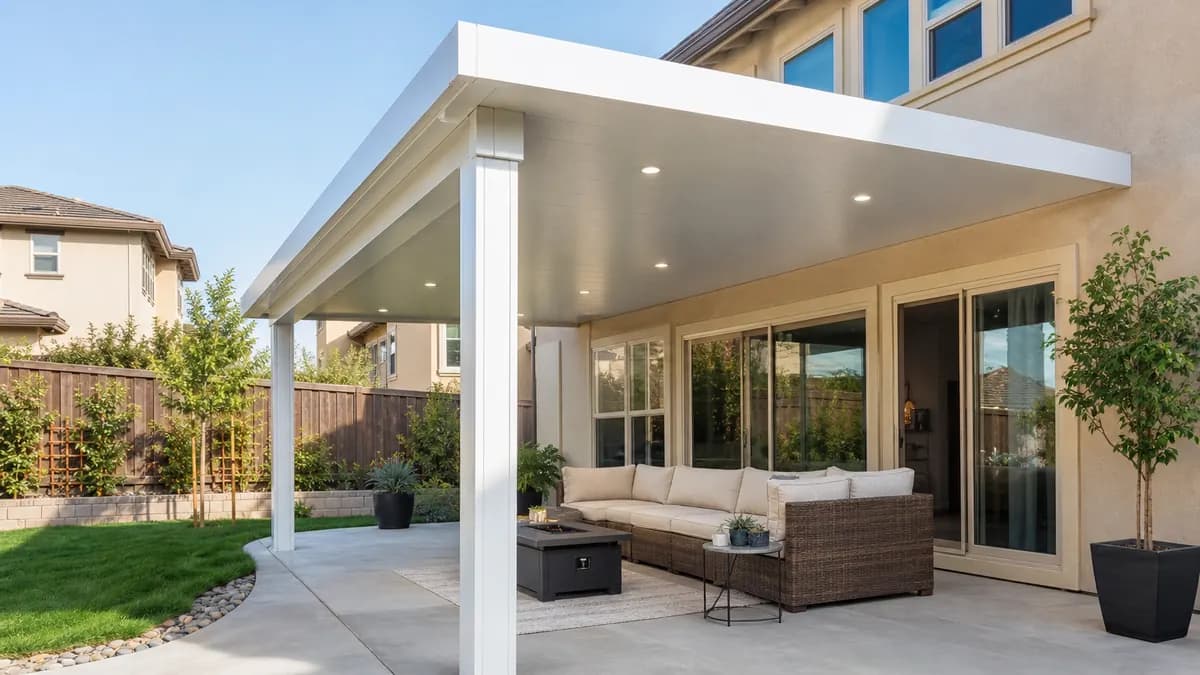
Typical patio cover cost by type
These are typical installed ranges from national cost guides and contractor sources, 2025 to 2026. Sacramento-specific pricing data is thin, so treat them as a starting point for patio covers in Sacramento and expect installers to quote against your actual site.
| Type | Typical installed range | Notes |
|---|---|---|
| Aluminum solid or lattice cover | $20-$50 per sq ft | Materials alone run roughly $10-$15 per sq ft |
| Insulated aluminum (foam-core) | $30-$60 per sq ft | Another contractor source puts it at $35-$55 per sq ft |
| Wood patio cover, open lattice | $20-$40 per sq ft | Cedar and redwood sit at the high end |
| Wood patio cover, solid roof | $35-$120 per sq ft | Wide spread; sources disagree, so ask for itemized quotes |
| Prefab pergola | $10-$40 per sq ft | Roughly $1,450-$5,750 installed |
| Custom pergola | $30-$65 per sq ft | Aluminum or vinyl materials about $10-$30 per sq ft; cedar $25-$35 |
| Louvered pergola, manual | $45-$110 per sq ft | Whole-project average $6,500-$18,000 |
| Louvered pergola, motorized | $55-$125 per sq ft | Some contractors report $120-$160 per sq ft on most projects |
| Retractable awning, motorized | $1,000-$6,000 installed | A 12 ft width is about $1,900-$3,300 |
| Shade sail, professional install | $15-$35 per sq ft | $600-$8,000 per project; a 20x20 four-post install can reach $8,000-$10,000 |
| Sunroom, three-season | $10,000-$40,000 | Four-season units run $25,000-$120,000 |
Premium Sacramento louvered units from local dealers are commonly quoted well above national averages, often in the $40,000-$60,000 range installed for large, fully featured systems. Sacramento pergolas overall span about $2,500 for a prefab kit to $75,000 for custom louvered work, with most landing between $10,000 and $40,000. Those local figures come from a vendor with a sales interest, so weigh them accordingly.
What a 10x10 versus a 12x20 looks like
Per-square-foot ranges make more sense with a footprint. At $20-$50 per sq ft, a 10x10 (100 sq ft) solid aluminum cover lands around $2,000-$5,000, while a 12x20 (240 sq ft) lands around $4,800-$12,000. One Los Angeles contractor publishes about $3,280 for a 10x10 lattice and up to about $7,028 for a 10x10 insulated cover, which fits inside those spreads. Smaller jobs tend to cost more per square foot because mobilization, permit handling and engineering do not shrink with the roof.
Where each range comes from
The aluminum and louvered figures come from HomeGuide cost data, the sunroom figures from Angi, and the awning and shade sail figures from HomeGuide and installer sites. Contractor blogs are marketing documents, so we show ranges instead of single prices.
Aluminum versus insulated: the biggest cost split
Most Sacramento homeowners are choosing between a solid or lattice aluminum patio cover and an insulated patio cover. The difference is the roof panel. Insulated panels are typically 3, 4 or 6 inches thick, with .024-inch aluminum skins on both faces over a 1.5 lb EPS foam core. That sandwich costs more to make and to engineer, but it is the option that cools the space underneath.
Why insulation is worth pricing in Sacramento
Sacramento averages about 23 days at or above 100 degrees F per year, and 2024 set a record with more than 45 triple-digit days. Average July highs sit in the mid-90s. A 3-inch insulated panel is rated around R-13.95 by one vendor, and vendors claim the space underneath runs 15-20 degrees F cooler than an uninsulated pan. Treat that as a manufacturer claim, not a measured result for your yard.
When non-insulated is the smarter spend
If the patio is used mainly in evenings, or the cover shades a west wall that is already shaded by a mature tree, lattice or a solid non-insulated pan can be the better value. Ask the installer to quote both so the difference is itemized.
What drives your quote up or down
Two covers of the same size can differ by thousands of dollars. These are the factors installers in our network price in most often.
| Factor | Effect on price |
|---|---|
| Roof type | Lattice is cheapest, solid aluminum is mid-range, insulated and louvered cost the most |
| Size and span | Longer rafter spans need heavier beams and more posts |
| Attached versus freestanding | Freestanding needs four posts and footings; attached shares the house wall but needs a proper ledger connection |
| Footings and slab | Posts on an existing slab may avoid new footings; new footings add labor and inspection |
| Electrical | Lights, fans and heaters add wiring, and electrical work is part of the permit |
| Engineering | A stamped design is needed when the structure is not a listed or standard-plan system |
| Finish and color | Standard colors cost less than custom powder-coat or wood-grain embossing |
| Site access | Narrow side yards, slopes and tear-out of an old cover add labor |
| Timing | Spring and early summer are busy, which can lengthen schedules and stiffen pricing |
Footings, snow load and wind
Valley sites usually follow the product's evaluation report or a county standard plan. In the foothills, El Dorado County treats the whole county as snow country with an absolute minimum roof snow load of 20 psf, so covers in El Dorado Hills and Cameron Park can need heavier framing than comparable covers on the valley floor. The 2025 California Building Code adopts ASCE 7-22 for wind, and the design value for your address is something the installer or engineer confirms.
Electrical, lighting and fans
Recessed lights, ceiling fans and outlets are line items of their own. Ask whether the electrical is priced inside the base quote or as an add-on, since it also affects the permit.
Permit and plan fees
Permit fees vary by city and are usually based on project valuation, with plan check and inspection billed separately. California-wide, residential patio permits commonly fall somewhere between a few hundred dollars and about $1,500, and some jurisdictions charge more. We do not have a verified Sacramento-area fee table, so confirm with the building department before budgeting. The City of Sacramento publishes a dedicated pre-engineered patio cover fee category on its building fees page.
Any attached patio cover needs a permit in the City of Sacramento, Sacramento County, Elk Grove, Roseville, Rocklin and the other nearby jurisdictions. Our patio cover permits guide covers which offices accept listed systems and where a standard plan can reduce engineering cost.
Engineering and HOA submittals
If the design is not a listed system or a standard plan, a California-licensed engineer's stamp can add a line item. Neighborhood associations may also want drawings; see patio cover HOA approval.
Comparing quotes without getting burned
The only price that counts is the written quote from the licensed contractor you are matched with. Since patio covers nearly always need a building permit, California requires a licensed contractor at any price. The minor-work exemption (now $1,000 under AB 2622) applies only to jobs that need no permit.
Check these items on every quote
- Square footage, post count, beam size and panel thickness spelled out
- Who pulls the permit and whether the permit and engineering fees are included or billed separately
- Electrical, lighting and fan scope
- Removal and disposal of an old cover
- Payment schedule: the down payment is limited by California law to 10 percent of the contract price or $1,000, whichever is less, and progress payments cannot exceed the value of work completed
- Contractor license class, verified on the CSLB site at cslb.ca.gov
Louvered and wood quotes need extra scrutiny
Louvered systems vary widely in motor, sensor and structural options, so compare line by line. For wood, ask for species and grade of lumber; a permit set typically calls this out, such as Douglas fir #2 rafters at 16 inches on center. The louvered versus solid patio covers and aluminum versus wood guides explain the trade-offs behind the price gaps.
Long-term cost: maintenance and lifespan
Sticker price is only part of the cost. Installer sources commonly cite 25 to 30 years or more of life for aluminum with minimal care, versus roughly 15 to 20 years for wood even when maintained, plus restaining every one to three years. Those are contractor-side figures, so use them directionally. A wood patio cover that costs less up front can cost more over its life once refinishing is counted, while a natural wood look may be worth it to you.
Repair costs also vary. Our patio cover repair page covers common fixes for older covers.
Back to the main guide: patio covers in Sacramento.