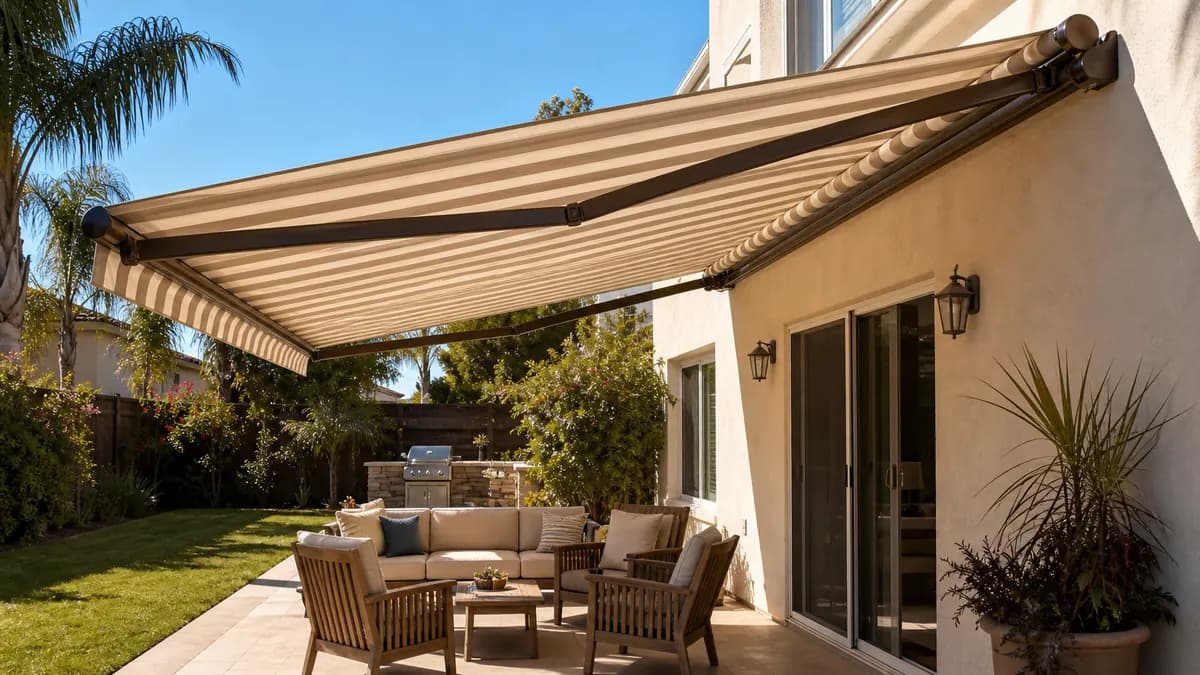
How a Retractable Awning Works
A retractable awning is a roll of fabric on a torsion tube, mounted to the house wall or fascia, with two articulating arms that push a front bar outward. The fabric extends to shade the patio and rolls back up when you want sun or when weather turns. The shade is adjustable, which is the main reason people choose it over a fixed roof.
Most units are sold by width and projection. Typical widths run from about 8 ft to well past 20 ft, and common projections reach roughly 10 ft from the wall. A wider, deeper awning needs stronger arms and a stronger wall attachment, so the installer checks what is behind the wall before quoting.
Wall-mount vs. fascia-mount vs. ceiling-mount
Wall mounting bolts brackets into the studs or a structural header of the house. Fascia mounting uses the rafter tails or fascia board, which must be solid and not rotted. Ceiling mounting fits under an eave. Stucco homes common in Sacramento subdivisions usually need brackets located into framing, not just the stucco finish.
Motorized vs. manual
- Motorized: a tubular motor with a wall switch or remote, and often a wind and sun sensor that extends and retracts automatically.
- Manual crank: a hand crank on a gear box. Lower cost, no wiring, but you have to be home to retract it.
- Hardwired vs. plug-in: motorized units need power at the wall. If there is no outlet nearby, the installer may need an electrician, and electrical work can trigger its own permit.
Fabric, Frames and Wind Limits
Fabric choice drives how long the awning looks good in Sacramento's sun. Solution-dyed acrylic, where the color runs through the fiber, is the usual high-end choice because it resists fading. Vinyl-coated polyester is sold as a more water-resistant option. Ask the installer which fabric is quoted and what the manufacturer's fabric terms are, in writing.
Frame and cassette
Frames are powder-coated aluminum or steel. A full cassette or hood closes around the rolled fabric and protects it from dust and sun when retracted, which matters in a dry climate with long summers. Open-style units cost less but leave the rolled fabric exposed.
Wind sensors and ratings
A retractable awning is shade equipment, not a roof. Manufacturers generally rate them for light to moderate wind, often cited around 20 to 25 mph, and recommend retracting before stronger gusts. A wind sensor retracts a motorized awning automatically when gusts pick up, and it is worth specifying for any unit you will not always be home to manage. Rain is similar: most are meant to be retracted in heavy rain so water does not pool on the fabric.
What Retractable Awnings Cost in Sacramento
National cost guides put a motorized retractable awning at roughly $1,000 to $6,000 installed. By width, typical installed figures are about $1,300 to $2,200 for an 8 ft unit, $1,700 to $2,700 for 10 ft, and $1,900 to $3,300 for 12 ft. Labor for large or motorized units typically adds $400 to $1,000 on top of the equipment.
| Width | Typical installed range |
|---|---|
| 8 ft | $1,300 - $2,200 |
| 10 ft | $1,700 - $2,700 |
| 12 ft | $1,900 - $3,300 |
These are typical ranges that vary by size, product and site. Wide units, cassette models, built-in lights, and difficult mounting surfaces push the price up. The installer's written quote is what counts. For a broader comparison across product types, see patio cover cost in Sacramento.
Permits for Awnings in the Sacramento Area
The California Residential Code exempts window awnings supported by an exterior wall that project no more than 54 in. and need no additional support. El Dorado County's handout repeats that exemption. A deep patio awning that projects 8 to 10 ft or is mounted on posts or a frame is a different case, and the installer should confirm with the local building department whether a permit applies.
Local rules differ across Sacramento County, the cities, and El Dorado and Placer counties. If the awning is wired in, the electrical connection can be permitted work. See patio cover permits in Sacramento County for how the process generally runs.
California law requires a licensed contractor for work that needs a building permit. The CSLB D-03 (Awnings) classification covers installing and repairing aluminum, metal, vinyl or canvas awnings. Homeowners can check any license at cslb.ca.gov.
Retractable Awning vs. Fixed Patio Cover
An awning gives adjustable shade for less money and mounts in a day. A fixed cover gives rain protection, outdoor lighting and fans, and no fabric to replace. Many Sacramento homeowners choose an awning for a south or west-facing window wall and a cover for the main patio.
- Pick an awning for a small patio, a rental-style budget, or shade only on summer afternoons.
- Pick a [solid or lattice aluminum cover](/aluminum-patio-covers) for year-round use, rain, and a lower maintenance load.
- Pick a [louvered pergola](/louvered-pergolas) when you want adjustable light and a roof-like structure.
Maintenance and Fabric Life
Fabric ages from UV, dust and pollen. Rinse it with mild soap and water, let it dry fully before retracting for long periods, and retract it in wind and rain. Keep oak and sycamore debris off the fabric and out of the arms.
Fabric is the wear item. Frames and arms usually outlast it, and the fabric can be replaced on the existing frame. Motor and sensor failures are the other common service calls. Ask the matched installer whether fabric replacement and motor service are done by their company after the sale.
How to Get Matched
Use the contact form to describe the wall, patio size and whether you want motorized control. We connect you with vetted, licensed local installers in our network. The installer you are matched with measures the site, checks the mounting surface, and gives you a written quote.
Back to the main guide: patio covers in Sacramento.