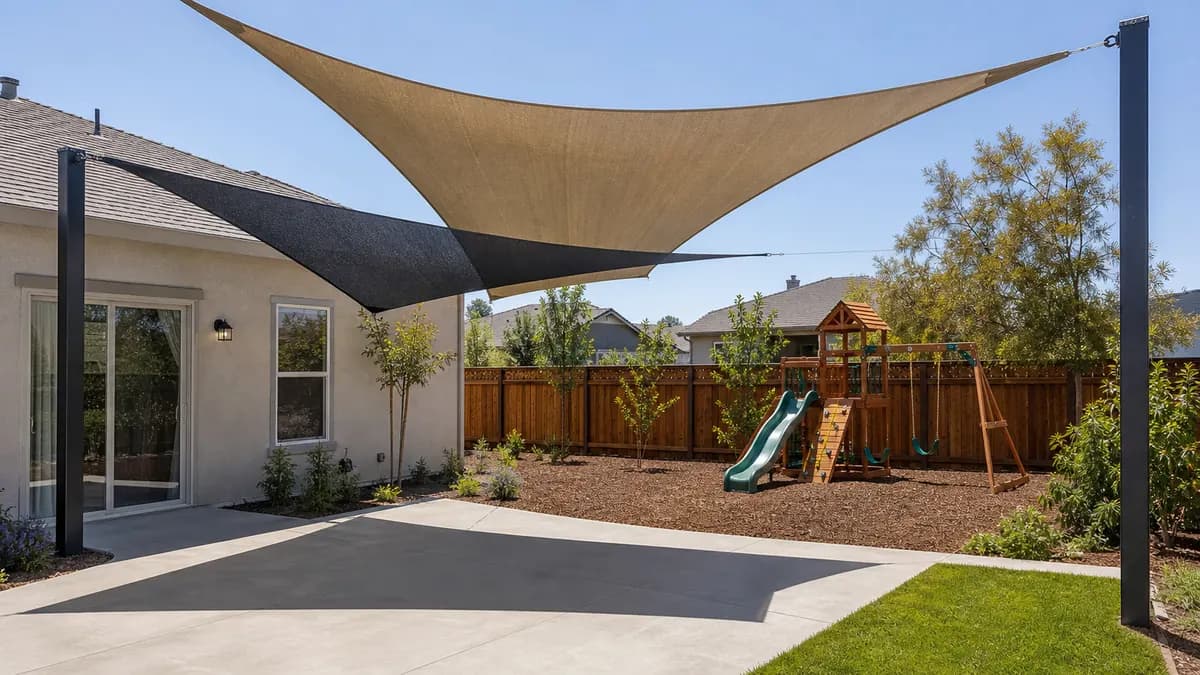
How Shade Sails Work
A shade sail is a piece of fabric pulled taut between three or more anchor points, with the corners set at different heights so the fabric twists into a curve. The twist sheds wind and, with a pitch, water. Sails are usually installed in overlapping pairs or groups for coverage and a layered look.
The load on each anchor is large. A sail is a tensioned structure, so a few hundred square feet of fabric concentrates its force at the corner fittings. That is why anchor design matters more than the fabric.
Triangle, square and rectangle
Triangles are the most forgiving and need only three anchor points. Squares and rectangles need four and a height difference between opposite corners; a flat, equal-height installation sags and pools. Layout is easier to get right with the installer measuring on site.
Fixed vs. retractable sails
Most sails are fixed. Retractable versions use a track and cable system so you can pull the sail back; they cost more and have more moving parts.
Fabric, Hardware and Posts
Breathable HDPE vs. waterproof fabric
Most residential sails use knitted high-density polyethylene (HDPE) shade cloth. It is breathable, so hot air passes through, and it lets some rain drain. Common weights are around 320 gsm (grams per square meter), and commercial grades report UV block up to the mid-90 percent range, with fabric terms of around a decade offered by some manufacturers. Waterproof PVC-coated fabric sheds rain but traps heat and creates more wind load, so it needs stronger anchors and a steeper pitch.
Hardware
Corner fittings are 304 or 316 stainless steel: D-rings, turnbuckles, eye bolts and snap hooks. Check that the hardware is rated for the loads, not hardware-store grade. Turnbuckles allow you to retighten the sail, because HDPE stretches slightly over time.
Posts and anchors
- Steel posts set in concrete footings are the standard for free-standing sails. Footing depth and diameter are set by the installer's design and soil conditions, not a rule of thumb.
- House attachment needs a structural fascia, rafter or wall framing, not just stucco or trim. Rotted fascia boards are a common reason an anchor fails.
- Existing trees are not suitable anchors.
Wind, Sun and Sacramento Conditions
Sacramento's strong summer sun and afternoon Delta breezes make sails a good fit, but they are shade, not a roof. Sails can be damaged by high winds and many owners take them down during storms, particularly waterproof sails. HDPE sails pass wind through and handle gusts better. In the foothills, such as El Dorado County where all areas are treated as snow country with a 20 psf minimum roof snow load, a sail should be removed or designed for snow before winter.
Orientation matters. Place the lowest corners on the west and south sides to block low afternoon sun, and leave a gap at the high corners for hot air to escape.
Permits for Shade Sails
Rules vary by jurisdiction. Placer County lets free-standing, portable membrane shades go without a county permit if they are 200 sq ft or less with a portable foundation. Permanent sails with set posts, or sails attached to the house, typically need a permit. Cities such as Elk Grove list attached patio covers and shade structures of any size as permitted, and detached shade structures over 120 sq ft.
Zoning setbacks apply even where no building permit is required. Check with the installer before ordering. See patio cover permits in Sacramento County for the general process, and patio cover HOA approval if your community has an architectural committee, since many HOAs regulate sail color and visibility.
What Shade Sails Cost
Professional installation is commonly quoted at about $600 to $8,000 per project, with simple installs near $15 to $35 per sq ft. A large four-post install around 20 x 20 ft can reach $8,000 to $10,000 once posts and footings are included. Prices are typical and vary by size, product and site; the installer's written quote is what counts.
| Item | Typical range |
|---|---|
| Professional sail install (per project) | $600 - $8,000 |
| Simple installs | $15 - $35 per sq ft |
| Large four-post install | $8,000 - $10,000 |
Compare with a permanent cover on patio cover cost in Sacramento.
Shade Sails vs. Other Shade Options
- vs. [retractable awning](/retractable-awnings): a sail is cheaper per square foot and covers freestanding areas; an awning attaches to the house and can be retracted.
- vs. [pergola](/pergolas): a pergola is a permanent structure with more presence and permit weight; sails can be added to a pergola frame as a seasonal shade.
- vs. [aluminum patio cover](/aluminum-patio-covers): a cover blocks rain and sun year-round and lasts longer, at a higher cost.
Maintenance and Replacement
Rinse fabric with mild soap and water, check turnbuckles and fittings each spring, and re-tension as the fabric relaxes. Fabric is the wear item and is usually replaced while posts and hardware stay. Take sails down for severe storms. Describe your yard on the contact form and we connect you with installers in our network.
Back to the main guide: patio covers in Sacramento.