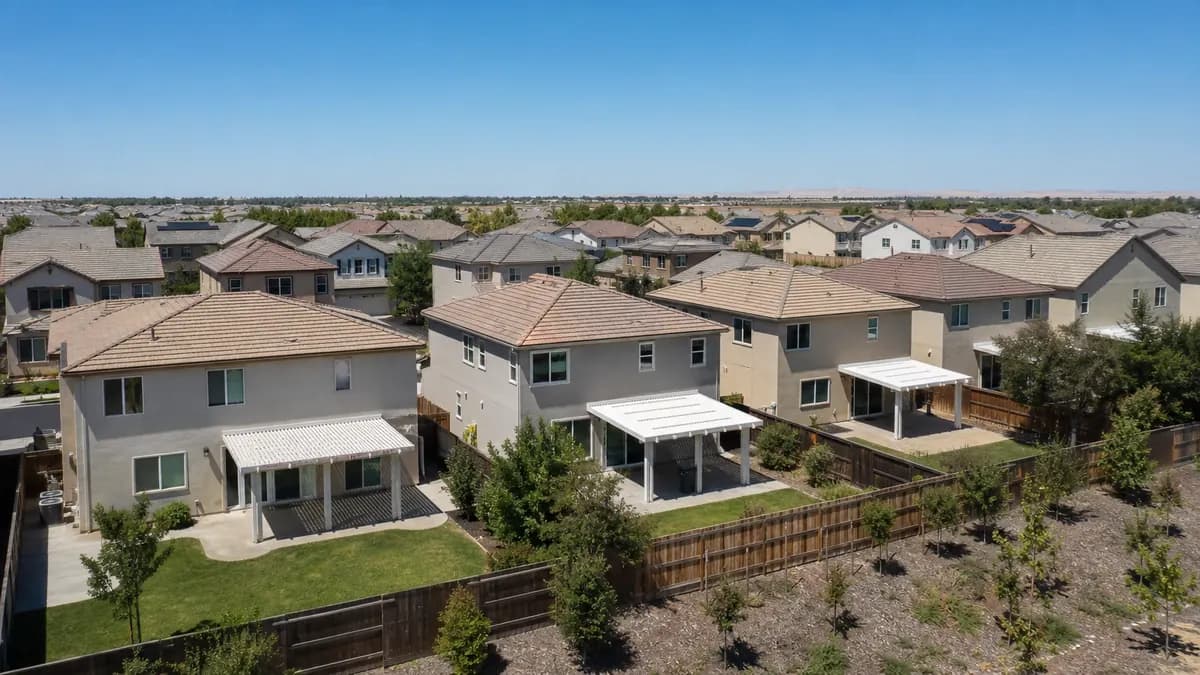
Which cover fits a Natomas backyard
Most Natomas housing is tract-built: South Natomas went in as residential subdivisions between the 1950s and 1980s, while North Natomas grew rapidly after the 1990s flood-control plan lifted development limits. The two eras produce very different yards, and the right cover follows the lot.
North Natomas: small lots, two-story stucco
Newer villages such as Westlake, Creekside and Gateway West typically have shallow rear yards and two-story homes whose second-floor windows face the patio. Attached solid or insulated aluminum covers keep depth modest and use the existing wall as the ledger line. Insulated panels (commonly 3 to 6 in. thick with thin aluminum skins over an EPS foam core) matter here because a west-facing stucco wall on a small lot radiates heat into the evening.
On very tight yards a freestanding louvered pergola can crowd the setbacks, so the installer's site measurement decides it. See louvered pergolas for how the adjustable-blade systems work.
South Natomas and Regency Park: older single-story ranches
Single-story homes from the mid-century and later decades usually have wider rear yards and lower eaves. Lattice covers, wood patio covers with exposed beams and attached solid aluminum all fit. Older roof framing is worth a look: the installer should confirm where the cover's ledger attaches and whether the rafters can carry the connection.
City of Sacramento permits for Natomas covers
Natomas is in the City of Sacramento, not unincorporated Sacramento County. Permits go through the Community Development Department, Building Division at 300 Richards Blvd., 3rd Floor, Sacramento, CA 95811. The help line is (916) 264-5011.
- A permit is required for any structure attached to the house, regardless of size, and for any detached structure of 120 sq ft or more.
- Unconditioned single-story detached structures under 120 sq ft do not need a building permit, but zoning still applies.
- Gas, mechanical or electrical work, such as ceiling fans on new circuits, is permitted separately in association with the cover.
- The city applies the 2025 California Residential Code.
Listed covers can skip plan review
The city accepts covers built to an ICC or IAPMO evaluation report without separate plan review, and it keeps a dedicated pre-engineered patio cover fee category. A site plan still goes to Planning first because setbacks are set by zoning, and the city's handout gives no fixed numbers. Wood covers are different: plans must name lumber species and grade, with spans checked against the CRC span tables.
Statewide, a patio cover job needs a licensed contractor because the permit requirement removes the small-job exemption. For the general process see permits in Sacramento County, and note that county rules differ from the city's.
HOAs and Mello-Roos in Natomas
Many newer Natomas subdivisions carry an HOA and a Mello-Roos special tax. Reported HOA dues in newer communities range widely (one new community lists roughly $58 per month, another roughly $135), and Mello-Roos figures often run into the low hundreds per month, which is why buyers in these villages tend to budget carefully for outdoor upgrades.
An HOA architectural committee can restrict color, height, roof material and visibility from the street, separately from the city permit. California Civil Code 4765 requires a written decision that explains its reasons. Submit the HOA application before or alongside the permit set, and ask the matched installer to include elevations and a color sample. More in HOA approval for patio covers.
Heat and sun in the Natomas basin
Natomas is flat valley floor with little tree canopy in the newer villages, so afternoon sun hits patios directly. Sacramento averages about 23 days a year at or above 100F, and 2024 passed 45 triple-digit days. Average July highs are in the mid-90s.
- West-facing patios benefit most from insulated panels or a louvered system that can be angled against the low sun.
- Lattice gives dappled shade but little rain protection.
- Retractable awnings and shade sails suit smaller budgets: awnings run roughly $1,000 to $6,000 installed, sails about $15 to $35 per sq ft for simple installs.
Typical costs for Natomas homeowners
Ranges below are typical and vary by size, product and site. The installer's written quote is what counts.
| Cover type | Typical installed range |
|---|---|
| Solid aluminum | $20 to $50 per sq ft |
| Insulated aluminum | $30 to $60 per sq ft |
| Louvered pergola | $45 to $125 per sq ft |
| Motorized retractable awning | $1,000 to $6,000 |
Small Natomas yards mean modest square footage, which keeps total project cost in a lower band than a large foothill lot. See the cost guide for the full breakdown.
Nearby areas
Across the river, West Sacramento has its own city rules, including a rear setback. For the whole region start at patio covers in Sacramento.
Back to the main guide: patio covers in Sacramento.